Help Your Tween Handle Stress

Help your tween handle stress

How to teach your children effective ways of handling stress

by Dr. Caron Goode

For many people the words childhood and carefree are interchangeable. Lazy summer days, best friends, and Friday night pizza parties are the stuff childhood memories are made of. Unfortunately, so is stress. Stress, the overwhelming feeling of self-doubt in one’s ability to cope, has become as much a part of childhood as Little League.

Children experience stress in different ways during different stages in their development. An elementary age child may complain of stomach aches and headaches. Older children might become irritable or depressed, while teens may rebel. In the case of my daughter, her middle school years were fraught with low self-esteem and sleepless nights.

I began to notice a change in her behavior in seventh grade shortly after she joined the track team. She had always been an active child. She played basketball for a local league and was on the swim team at our neighborhood pool. Therefore, when she tried out for her middle school track team, I wasn’t surprised. At first, she met the challenge of daily practice and Saturday meets with enthusiasm. Towards the middle of the season, however, there was a change in her attitude. Her stories about practice were not as animated as they once were. I had also started to notice dark circles under her eyes. When I asked if everything was alright, her reply was a meek and unconvincing, “Sure.”

Helping Infants and Toddlers Develop Language Skills

Reading to Infants

by Gerry Haggard

There are joys that come with the presence of a tiny child in the home. There are also important responsibilities placed on the caregivers. One of these is modeling beginning language skills that serve as the foundation of learning to read.

How can caregivers communicate with an infant? That very small person’s first attempt to communicate is crying, telling someone that he has a need. Listening parents learn to identify reasons for the crying. An adult can respond, meet the need, and speak in sentences of three words. “Are you wet?” etc.

Even before the age of six months, the baby begins to babble using vowels and consonant sounds that compose his home language. From birth on, singing and listening to nursery rhymes provide modeling for the sounds and words we want the child to produce.

Surviving Your First Year as a Stay at Home Mom

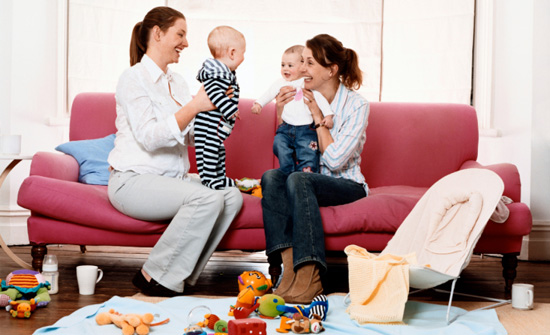
Stay at Home Moms - Playdate with Babies

How to be a Stay at Home Mom


by Kerrie McLoughlin

Congratulations! You’ve taken the plunge into the zany SAHM (stay at home mom) pool. While expecting your baby, you may have envisioned days of doing exactly what you wanted to do while your baby snoozed away, but you have probably by now realized that your tiny, new — permanent — houseguest is running the show. Now what?

Should Allowance be Tied to Chores?

Chores for Kids - Girl holding folded towels

Do you expect your kids to do chores to earn allowance?


by Kerrie McLoughlin

The word “allowance” might conjure up images of trust-fund kids and seems to hint at getting paid to do nothing. Poll a few of your friends about whether or not kids should get an allowance, and you’ll hear all sorts of answers. I’ve found there are several different camps on this issue, including those who believe kids should:

  1. do chores because they get a place to sleep and food to eat
  2. be paid by the chore to learn the value of working for money
  3. receive a set amount of money every week to do chores as needed or
  4. be paid an allowance to learn how to manage money

For Moms: How to Bond with Your Tween Daughter

Bonding Over Beauty book encourages mother daughter relationships


Over the long weekend I made some time to sit down with a great new book, Bonding Over Beauty: A Mother-Daughter Beauty Guide to Foster Self-Esteem, Confidence and Trust, by Erika Katz. As the mother of an almost 11-year-old daughter, I am always looking for new ways to stay connected to my tween daughter and ways to talk to her about all the changes she is about to experience in her body.

What to do when you have a shy child

Nurturing Social Growth in Your Child

by Dr. Caron B. Goode

I birthed a social butterfly named Kristin. From the day of her birth, she saw all people as her friend and always said hello. My friend, Karen, birthed a shy daughter named Lisa. Parents don’t often worry about how social butterflies flit through the world; however a shy child usually needs a parent’s help in learning to negotiate relationships in a safe way. Karen understood this. Here is how she helped Lisa.

Karen’s daughter was painfully shy until she entered second grade. When she did interact with other children, it was on a very selective basis and always one-on-one. This was of great concern to her teachers. For a few years, Lisa’s progress reports all read the same: Needs improvement in group interaction and socialization.

Karen was always an optimist and thankful that Lisa wasn’t disruptive in class! Still, it was Karen’s job to usher Lisa into the world of friendships and group dynamics. Karen joined a playgroup and invited classmates over. She and Lisa took part in their local babysitting coop and signed her up for pee wee soccer. Lisa was a good sport about all this socialization. She entered into each situation with her chin up and her eye peeled for the one child she would interact with. So much for group dynamics.

Your Teen’s Most Annoying Response? Whatever!

guide to teen self-esteem

Getting Beyond Whatever

In December 2011, the annual Marist Poll revealed that “whatever” had for the third consecutive year been judged as the most annoying conversational word or phrase in the English language.  Indeed, nearly four in ten adults in the United States found this word obnoxious.

What is it about the word “whatever” that gets people so worked up?  Its continual usage is certainly a contributing factor.  Whenever people don’t want to commit to a particular opinion, choice or course of action this word gets trotted out.   The excessive use of the word, however, is only part of the problem because the attitude that accompanies it is, arguably, what really gets people hot under the collar.  Think about it.  Whenever someone says the word “whatever” they generally roll their eyes, curl their lip and apathetically shrug their shoulders.   These gestures aren’t exactly pretty and this is because they convey an air of contempt along with a “count me out” stance.